My Honest Review of Active Recall After Using It for One Full Semester
I was skeptical. Flashcards felt like something you did in middle school. But after a rough midterm, I gave active recall a real shot — and I'm not going back.
Maya R.
Junior, Biology major
Study Techniques · EZ Grades
I failed my first Biochemistry midterm. Not spectacularly — I got a 61 — but enough to shake me. I'd spent hours re-reading my notes, highlighting, and watching lecture recordings. I thought I knew the material. Turns out I just recognized it when I saw it, which is not the same thing at all.
A friend in my study group mentioned active recall. I'd heard of it before but always dismissed it as "just flashcards." She explained it differently: the whole point is to force your brain to retrieve information without any cues. Close the book, blank page, write down everything you know. That's it.
Why Recognition Isn't the Same as Recall
This was the biggest mindset shift for me. When you re-read your notes, your brain says "yes, I've seen this before" and you feel like you know it. But on an exam, there's no text in front of you — you have to produce the information from scratch. That's a completely different cognitive task.
Researchers call this the "fluency illusion" — the feeling of knowing something because it looks familiar, even when you can't actually retrieve it independently. Re-reading creates fluency illusions. Active recall breaks them.
What I Actually Did

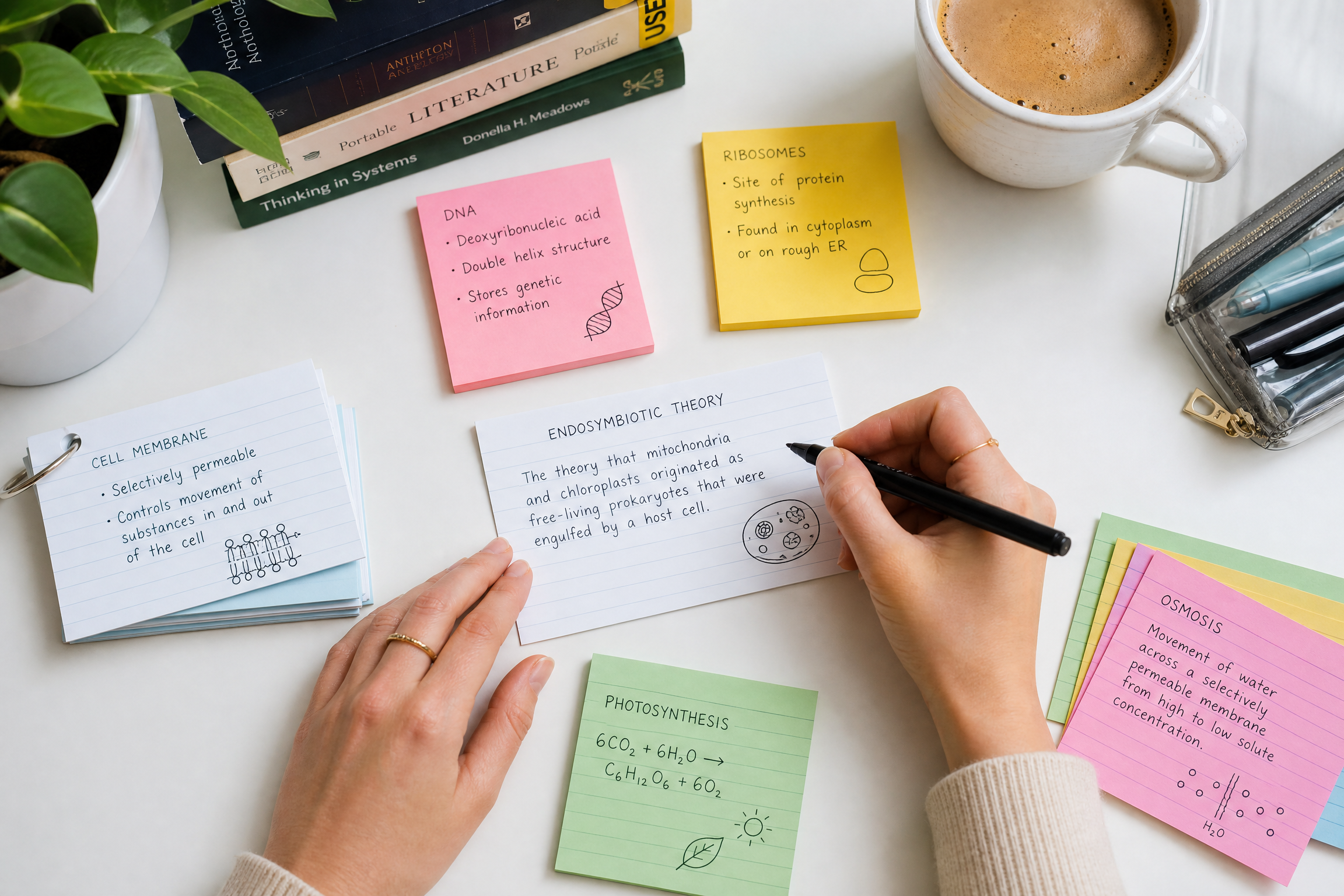
For the next exam, I changed my entire approach. After each lecture, instead of re-reading my notes, I'd flip them over and try to write out everything I could remember. Then I'd check what I missed. I made Anki cards for anything I kept blanking on.
It felt terrible at first. Sitting there staring at a blank page, unable to remember the steps of the Krebs cycle — it felt like I knew nothing. But that discomfort, I later learned, is literally the learning happening. The struggle to retrieve is what makes the memory stick.
The key habit I built: I'd do a "brain dump" immediately after class — blank page, write everything I remembered from the lecture, then check my notes to see what I missed. This took about 10 minutes and was the single most valuable thing I did all semester.
Building the Anki System
For anything I kept blanking on in my brain dumps, I'd make an Anki card. The app uses spaced repetition — it shows you cards more frequently when you're struggling with them and less frequently when you know them well. This means you're spending your review time exactly where it's needed.
The Anki part took some getting used to. The app's interface is a bit clunky, and setting up cards takes time upfront. But once I had a deck built, the spaced repetition scheduling meant I was reviewing things at exactly the right time — not too soon, not too late.
One rule I learned quickly: one fact per card. Instead of "explain the Krebs cycle," I'd have separate cards for each step, each enzyme, each product. It feels like more work upfront, but the reviews are much faster and more effective.
The Results

Second midterm: 84. Final exam: 88. Same amount of study time, completely different approach.
I'm not saying active recall is magic. It requires more mental effort than re-reading, and there were sessions where I genuinely couldn't remember anything and had to go back to my notes multiple times. But the difference in how well I retained things was undeniable.
What Worked Best for Me
The method that clicked for me was a combination of three things:
1. Post-lecture brain dumps. Immediately after class, blank page, write everything I remembered. Check notes. Note gaps. This took 10 minutes and was worth more than an hour of re-reading.
2. Anki for persistent gaps. Anything I blanked on in three consecutive brain dumps became an Anki card. This kept my deck focused on genuine weak spots rather than things I already knew.
3. Practice problems without notes. Before each exam, I'd work through practice problems with my notes closed. Then I'd check my answers and go back to review anything I got wrong. The combination of doing problems and checking answers is more effective than either alone.
What Didn't Work
I tried the "teach it to a rubber duck" variation — explaining concepts out loud to an imaginary student — and honestly felt a bit silly. Some people swear by it. For me, writing it out worked better than saying it out loud.
I also tried doing active recall in a group setting once, where we'd quiz each other. That was actually really fun and I'd recommend it — but it requires everyone to be on the same page with the material, which doesn't always happen.
The biggest mistake I made early on: peeking at my notes when I blanked. It felt less frustrating in the moment, but it defeated the whole purpose. The struggle is the mechanism. If you remove the struggle, you remove the learning.
How to Start If You've Never Done This
If you want to try active recall without committing to a full Anki setup, here's the simplest possible version: after your next class, close your notes and write down everything you remember on a blank piece of paper. Don't look anything up. Just write. Then open your notes and see what you missed.
That's it. That's active recall. Do that after every class for two weeks and see what happens to your exam scores.
Would I Recommend It?
Yes, but with a caveat: it only works if you actually commit to the discomfort. If you peek at your notes every time you blank, you're just doing a slightly more annoying version of re-reading. The point is to struggle, fail, check, and try again. That cycle is where the learning lives.
After a full semester of this approach, I can say with confidence: active recall is the most effective study technique I've found. Not the easiest — but the most effective.
Frequently Asked Questions
Q: How is active recall different from just doing practice problems?
Practice problems are one form of active recall — you're retrieving information to solve a problem. But active recall also includes brain dumps, flashcards, and self-quizzing without a formal problem set. Practice problems are great when they exist; brain dumps work for any subject.
Q: How long should a brain dump session take?
About 10–15 minutes per lecture. You're not trying to write everything — just everything you can remember without looking. The checking step (comparing to your notes) takes another 5 minutes. Total: 20 minutes per lecture, which is less time than most people spend re-reading.
Q: Is Anki worth learning if I'm not in a science or medical program?
Yes. Anki works for any subject with factual content: history dates, vocabulary, formulas, legal cases, coding syntax. The spaced repetition algorithm doesn't care what subject you're studying. The main question is whether your subject has enough discrete facts to make cards for — if yes, Anki is worth it.
Q: What if I blank completely and can't remember anything?
That's fine — and actually useful information. If you blank completely on a topic, it means you didn't encode it well in the first place. Go back to your notes, re-read that section carefully, and try again in 24 hours. The blank is telling you where to focus your attention.
Related Articles
I Made Mind Maps for Every Chapter of My History Textbook — Here's What Happened

90 Days with Anki: My Spaced Repetition Experiment (With Actual Stats)
