I Made Mind Maps for Every Chapter of My History Textbook — Here's What Happened
A walkthrough of my actual process: how I set up each map, what I put on them, and whether they actually helped me on the final exam.
James T.
Senior, Computer Science
Study Techniques · EZ Grades
I'm a visual thinker. Linear notes never really clicked for me — I'd end up with pages of bullet points that all looked the same and I couldn't see how anything connected to anything else. So when my AP World History teacher mentioned mind maps, I decided to go all in.
Here's my honest walkthrough of the process, including the parts that didn't work.
What Is a Mind Map, Actually?
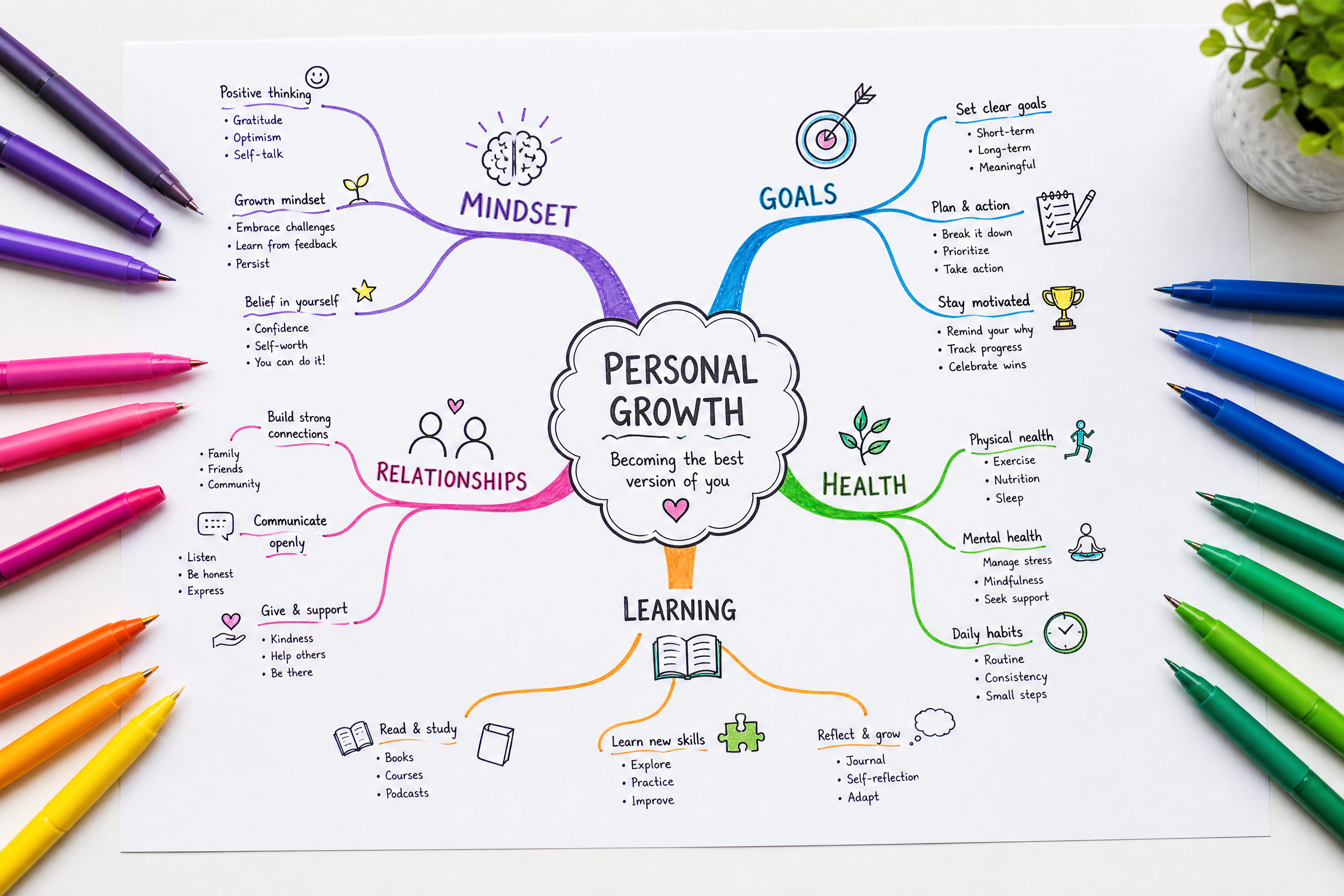
A mind map is a diagram that starts with a central concept and branches outward into related ideas, sub-ideas, and connections. Unlike linear notes that go top-to-bottom, a mind map spreads in all directions and lets you see relationships between ideas at a glance.
The theory behind them is that our brains don't store information in neat linear lists — they store it in networks of connected concepts. Mind maps try to match that structure, making information easier to encode and retrieve.
My Setup

I used paper for most of my maps, not an app. I know there are tools like MindMeister and XMind, but I found that drawing by hand forced me to think more carefully about what to include. I used a blank A3 sheet (the bigger the better) and a set of coloured pens — one colour per major branch.
The size matters more than you'd think. On an A4 sheet, you run out of space and the map gets cramped. On A3, you have room to breathe and add connections without it becoming unreadable.
How I Built Each Map
I'd start with the chapter title in the centre, circled. Then I'd skim the chapter headings and create one branch per major section. For a chapter on World War I, my branches were: Causes, Key Events, Major Players, Consequences, and Legacy.
Then I'd read the chapter properly and fill in the sub-branches as I went. I didn't try to put everything in — just the things that seemed most important or that I didn't already know.
The key habit I developed: after finishing a branch, I'd look for connections to other branches and draw dotted lines between them. This was actually the most useful part. Seeing that "nationalism" appeared under both Causes and Legacy made me think about it differently than I would have from a linear list.
The Mistake I Made in Week One

I tried to map while reading, which was a disaster. I'd read a sentence, try to figure out where it fit on the map, second-guess myself, and end up with a messy map that didn't reflect the chapter's actual structure.
The fix: read the whole chapter first, then close the book and build the map from memory. This turned the mapping process into active recall — I was retrieving information rather than just copying it. The map I built from memory was less complete than one I'd built while reading, but it was far more useful for studying because I'd already done the retrieval work.
What I Learned About the Process
The maps took about 45 minutes per chapter, which is longer than just reading. But when I sat down to review for the final, I could look at one map and reconstruct the whole chapter in my head. The visual structure made it much easier to remember than a list of notes.
I also noticed something unexpected: making the map forced me to decide what was important. When you're taking linear notes, you can write down everything without really thinking about it. When you're building a map, you have to choose what goes on it. That decision-making process is itself a form of learning.
Subjects Where Mind Mapping Works Best
History, biology, and literature are the best subjects for mind mapping in my experience. These are subjects where concepts connect to each other in meaningful ways — causes lead to events, events have consequences, characters influence each other.
Mind mapping works less well for math and chemistry, where the structure is more procedural (step 1, step 2, step 3) than conceptual. For those subjects, I stick to worked examples and practice problems.
Did It Help on the Exam?
I got an 89 on the final, which was my best history grade all year. I can't say for certain that the mind maps were the only reason — I also studied more consistently that semester. But when I was writing my essay answers, I could literally visualise the maps in my head and pull information from them. That felt different from any other studying I'd done.
For the essay questions especially, having a mental map of how ideas connected meant I could construct arguments more easily. Instead of trying to remember isolated facts, I could follow the connections on my mental map.
Digital vs. Paper: My Take
I've tried both. Paper is better for the initial creation because the physical act of drawing forces you to think. Digital tools (MindMeister, XMind, Miro) are better for revision and sharing — you can easily move branches around, add colour, and share with study partners.
My current approach: create on paper, then recreate digitally if I want to share or if the map needs significant reorganization.
My Honest Verdict
Mind mapping is genuinely useful, but it's not a shortcut. It takes time and effort to do well. If you're looking for a quick way to review, this isn't it. But if you're trying to understand how ideas connect — especially in subjects like history, biology, or literature — I think it's one of the best tools I've found.
The single most important thing: build the map from memory, not while reading. That's what makes it a learning tool rather than a note-taking tool.
Frequently Asked Questions
Q: Do I need special software to make mind maps?
No — paper and coloured pens work great, and many students find them better than digital tools because the physical act of drawing forces more careful thinking. If you want digital options, MindMeister and XMind both have free tiers. Miro is good for collaborative maps.
Q: How many branches should a mind map have?
For a textbook chapter, I typically have 4–6 main branches (one per major section or theme) and 3–5 sub-branches per main branch. More than that and the map gets cluttered. Less than that and you're probably missing important content.
Q: Can mind mapping replace regular notes?
For most subjects, no — mind maps are better as a review and synthesis tool than as a primary note-taking method. I take regular notes during lectures and then create mind maps afterward as a way to consolidate and connect the material.
Q: How long does it take to make a good mind map?
About 30–45 minutes for a textbook chapter, or 20–30 minutes for a lecture. The time investment is higher than re-reading, but the learning value is much higher too. Think of it as a study session, not just note organization.
Related Articles

My Honest Review of Active Recall After Using It for One Full Semester

90 Days with Anki: My Spaced Repetition Experiment (With Actual Stats)
